Child abuse is abhorrent. Society and the Church condemn it. The crime is so grave that ministries struggle to craft responses that are godly and balanced. Such responses require extraordinary judgment by ministry leaders. They must, at once, prevent abuse; afford due process; cooperate with law enforcement; avoid re-harming both known and unknown victims; provide compassionate assistance; protect confidences; preserve reputations of the innocent; discipline or remove offenders; comply with church law; and steward ministry resources. This article offers ministry leaders lessons from the Catholic sexual abuse scandal. These lessons are more necessary than ever as the dramatically declining settlements from Catholic institutions1 push plaintiffs' attorneys to develop new markets including Boy Scouts, Southern Baptists, Jehovah's Witnesses, Mormons, Orthodox Jews, some Protestant denominations, and missionary sending organizations.2 The Catholic prequel shapes allegations now surfacing against Protestant boarding schools. As the attack against Protestant ministries accelerates,3 some could face a threat of the magnitude that bankrupted eight Catholic dioceses and two Catholic religious orders.
I. The Problem of Child Sexual Abuse: Its Historic and Modern Scope. A. The Scope of the Child Sexual Abuse Problem. The terrible truth is that child abuse is epidemic. In 2009, government agencies received 3.3 million reports of child abuse
1 Catholic institutions annually paid settlements totaling, on average, $338 million from 2005 through 2008. This average dropped 84%--to $55 million--in 2009. 2009 Survey of Allegations and Costs 41 Center for Applied Research in the Apostolate (Georgetown University, 2009).
2John Jay College Research Team, "The Causes and Context of Sexual Abuse of Minors by Catholic Priests in the United States, 1950-2010," 17-18, 20-22 (2011) (Causes and Context Study).
3StopBaptistPredators.org and reformation.com provide a glimpse of the gathering storm for Protestant ministries.
1
involving six million children.4 This reported abuse averages 115,385 children per week; 16,483 per day. Parents, their partners, and relatives are responsible for 92% of child abuse.5 While experts disagree on the percentage of sexual abusers among the American male population, a conservative estimate is 1 in 10, and some peg it closer to 1 in 5.6
B. Child Sexual Abuse and the Catholic Church. Media coverage, the film industry, and rhetoric from victims' advocacy groups have created the perception that the problem of child sexual abuse is particular to the Catholic Church. It is not so. Four percent of the priests in ministry from 1950 to 2000, 1 out of 20, were accused of child sexual abuse.7 Thus, even including the years when the Catholic Church problem was at its worst, Catholic priests were only one-half to one-quarter as likely as the average American man to have engaged in child sexual abuse. The United States Department of Health and Human Services publishes the leading annual statistical study of child abuse reports, Child Maltreatment. It has never listed clergy as a statistically significant source of perpetration. No objective study has ever suggested that child sexual abuse occurs at a higher rate in the Catholic Church or religious settings generally.
These facts are contrary to popular perceptions. A 2002 poll found that 64 percent of those queried thought Catholic priests "frequently" abused children.8 One judge, ignoring the reality that millions of Americans find themselves situationally celibate for years on end, told our Catholic Church client that "any Church that does not allow a sexual outlet for its ministers ought to expect this type of thing to happen." While even one priest or clergyperson abusing a
4 U.S. Department of Health and Human Services, "Child Maltreatment 2009" 22 (2009).
5 Id. at 70.
6 Pat Wingert, "Mean Men," Newsweek, April 8, 2010 (also available at:
http://www.newsweek.com/2010/04/07/mean-men.html ).
7 Causes and Context Study, 8.
8 Pat Wingert, "Mean Men," Newsweek, April 8, 2010.
2
child is too many and while it is a disgrace that thousands of pastors and clergy have abused children, we know of no hard data suggesting that priests or other ministers have an outsized problem. The largest multi-denominational insurance companies report that they do not charge Catholic institutions higher rates for their sexual misconduct coverage. Their premiums are fairly even across denominational lines, and they only bump their rates for churches that have larger children's ministries.9
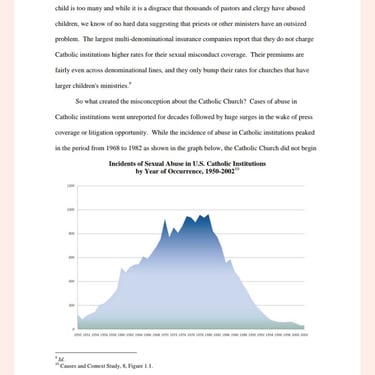
So what created the misconception about the Catholic Church? Cases of abuse in Catholic institutions went unreported for decades followed by huge surges in the wake of press coverage or litigation opportunity. While the incidence of abuse in Catholic institutions peaked in the period from 1968 to 1982 as shown in the graph below, the Catholic Church did not begin
Incidents of Sexual Abuse in U.S. Catholic Institutions by Year of Occurrence, 1950-200210
[image]
9 Id.
10 Causes and Context Study, 8, Figure 1.1.
3
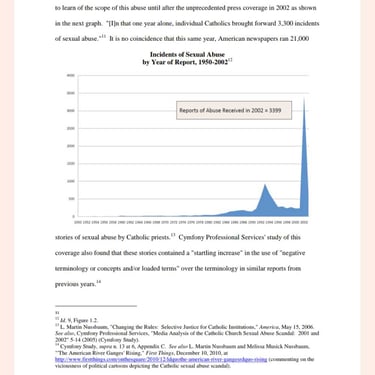
to learn of the scope of this abuse until after the unprecedented press coverage in 2002 as shown in the next graph. "[I]n that one year alone, individual Catholics brought forward 3,300 incidents of sexual abuse."11 It is no coincidence that this same year, American newspapers ran 21,000
Incidents of Sexual Abuseby Year of Report, 1950-200212
[image]
stories of sexual abuse by Catholic priests.13 Cymfony Professional Services' study of this
coverage also found that these stories contained a "startling increase" in the use of "negative terminology or concepts and/or loaded terms" over the terminology in similar reports from previous years.14
11
12 Id. 9, Figure 1.2.
13 L. Martin Nussbaum, "Changing the Rules: Selective Justice for Catholic Institutions," America, May 15, 2006. See also, Cymfony Professional Services, "Media Analysis of the Catholic Church Sexual Abuse Scandal: 2001 and 2002" 5-14 (2005) (Cymfony Study).
14 Cymfony Study, supra n. 13 at 6, Appendix C. See also L. Martin Nussbaum and Melissa Musick Nussbaum, "'The American River Ganges' Rising," First Things, December 10, 2010, at http://www.firstthings.com/onthesquare/2010/12/ldquothe-american-river-gangesrdquo-rising (commenting on the viciousness of political cartoons depicting the Catholic sexual abuse scandal).
4
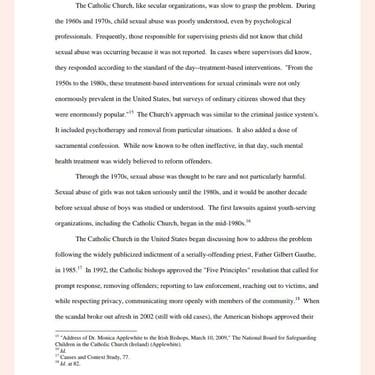
The Catholic Church, like secular organizations, was slow to grasp the problem. During the 1960s and 1970s, child sexual abuse was poorly understood, even by psychological professionals. Frequently, those responsible for supervising priests did not know that child sexual abuse was occurring because it was not reported. In cases where supervisors did know, they responded according to the standard of the day--treatment-based interventions. "From the 1950s to the 1980s, these treatment-based interventions for sexual criminals were not only enormously prevalent in the United States, but surveys of ordinary citizens showed that they were enormously popular."15 The Church's approach was similar to the criminal justice system's. It included psychotherapy and removal from particular situations. It also added a dose of sacramental confession. While now known to be often ineffective, in that day, such mental health treatment was widely believed to reform offenders.
Through the 1970s, sexual abuse was thought to be rare and not particularly harmful. Sexual abuse of girls was not taken seriously until the 1980s, and it would be another decade before sexual abuse of boys was studied or understood. The first lawsuits against youth-serving organizations, including the Catholic Church, began in the mid-1980s.16
The Catholic Church in the United States began discussing how to address the problem following the widely publicized indictment of a serially-offending priest, Father Gilbert Gauthe, in 1985.17 In 1992, the Catholic bishops approved the "Five Principles" resolution that called for prompt response, removing offenders; reporting to law enforcement, reaching out to victims, and while respecting privacy, communicating more openly with members of the community.18 When the scandal broke out afresh in 2002 (still with old cases), the American bishops approved their
15 "Address of Dr. Monica Applewhite to the Irish Bishops, March 10, 2009," The National Board for Safeguarding Children in the Catholic Church (Ireland) (Applewhite).
16 Id.
17 Causes and Context Study, 77.
18 Id. at 82.
5
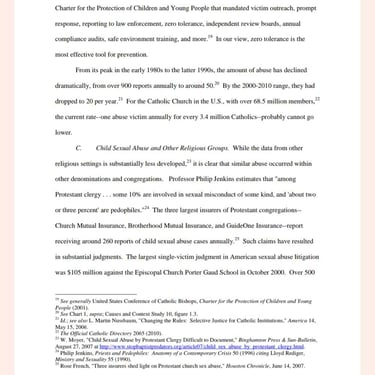
Charter for the Protection of Children and Young People that mandated victim outreach, prompt response, reporting to law enforcement, zero tolerance, independent review boards, annual compliance audits, safe environment training, and more.19 In our view, zero tolerance is the most effective tool for prevention.
From its peak in the early 1980s to the latter 1990s, the amount of abuse has declined dramatically, from over 900 reports annually to around 50.20 By the 2000-2010 range, they had dropped to 20 per year.21 For the Catholic Church in the U.S., with over 68.5 million members,22 the current rate--one abuse victim annually for every 3.4 million Catholics--probably cannot go lower.
C. Child Sexual Abuse and Other Religious Groups. While the data from other religious settings is substantially less developed,23 it is clear that similar abuse occurred within other denominations and congregations. Professor Philip Jenkins estimates that "among Protestant clergy . . . some 10% are involved in sexual misconduct of some kind, and 'about two or three percent' are pedophiles."24 The three largest insurers of Protestant congregations-- Church Mutual Insurance, Brotherhood Mutual Insurance, and GuideOne Insurance--report receiving around 260 reports of child sexual abuse cases annually.25 Such claims have resulted in substantial judgments. The largest single-victim judgment in American sexual abuse litigation was $105 million against the Episcopal Church Porter Gaud School in October 2000. Over 500
19 See generally United States Conference of Catholic Bishops, Charter for the Protection of Children and Young People (2001).
20 See Chart 1, supra; Causes and Context Study 10, figure 1.3.
21 Id.; see also L. Martin Nussbaum, "Changing the Rules: Selective Justice for Catholic Institutions," America 14, May 15, 2006.
22 The Official Catholic Directory 2065 (2010).
23 W. Moyer, "Child Sexual Abuse by Protestant Clergy Difficult to Document," Binghamton Press & Sun-Bulletin, August 27, 2007 at http://www.stopbaptistpredators.org/article07/child_sex_abuse_by_protestant_clergy.html. 24 Philip Jenkins, Priests and Pedophiles: Anatomy of a Contemporary Crisis 50 (1996) citing Lloyd Rediger, Ministry and Sexuality 55 (1990).
25 Rose French, "Three insurers shed light on Protestant church sex abuse," Houston Chronicle, June 14, 2007.
6
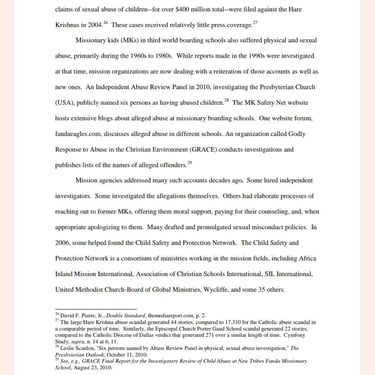
claims of sexual abuse of children--for over $400 million total--were filed against the Hare Krishnas in 2004.26 These cases received relatively little press coverage.27 Missionary kids (MKs) in third world boarding schools also suffered physical and sexual abuse, primarily during the 1960s to 1980s. While reports made in the 1990s were investigated at that time, mission organizations are now dealing with a reiteration of those accounts as well as new ones. An Independent Abuse Review Panel in 2010, investigating the Presbyterian Church (USA), publicly named six persons as having abused children.28 The MK Safety Net website hosts extensive blogs about alleged abuse at missionary boarding schools. One website forum, fandaeagles.com, discusses alleged abuse in different schools. An organization called Godly Response to Abuse in the Christian Environment (GRACE) conducts investigations and publishes lists of the names of alleged offenders.29
Mission agencies addressed many such accounts decades ago. Some hired independent investigators. Some investigated the allegations themselves. Others had elaborate processes of reaching out to former MKs, offering them moral support, paying for their counseling, and, when appropriate apologizing to them. Many drafted and promulgated sexual misconduct policies. In 2006, some helped found the Child Safety and Protection Network. The Child Safety and Protection Network is a consortium of ministries working in the mission fields, including Africa Inland Mission International, Association of Christian Schools International, SIL International, United Methodist Church-Board of Global Ministries, Wycliffe, and some 35 others.
26 David F. Pierre, Jr., Double Standard, themediareport.com, p. 2.
27 The large Hare Krishna abuse scandal generated 44 stories, compared to 17,310 for the Catholic abuse scandal in a comparable period of time. Similarly, the Episcopal Church Porter Gaud School scandal generated 22 stories, compared to the Catholic Diocese of Dallas verdict that generated 271 over a similar length of time. Cymfony Study, supra, n. 14 at 6, 11.
28 Leslie Scanlon, "Six persons named by Abuse Review Panel in physical, sexual abuse investigation," The Presbyterian Outlook, October 11, 2010.
29 See, e.g., GRACE Final Report for the Investigatory Review of Child Abuse at New Tribes Fanda Missionary School, August 23, 2010.
7
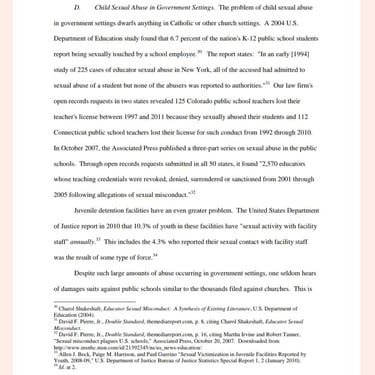
D. Child Sexual Abuse in Government Settings. The problem of child sexual abuse in government settings dwarfs anything in Catholic or other church settings. A 2004 U.S. Department of Education study found that 6.7 percent of the nation's K-12 public school students report being sexually touched by a school employee.30 The report states: "In an early [1994] study of 225 cases of educator sexual abuse in New York, all of the accused had admitted to sexual abuse of a student but none of the abusers was reported to authorities."31 Our law firm's open records requests in two states revealed 125 Colorado public school teachers lost their teacher's license between 1997 and 2011 because they sexually abused their students and 112 Connecticut public school teachers lost their license for such conduct from 1992 through 2010. In October 2007, the Associated Press published a three-part series on sexual abuse in the public schools. Through open records requests submitted in all 50 states, it found "2,570 educators whose teaching credentials were revoked, denied, surrendered or sanctioned from 2001 through 2005 following allegations of sexual misconduct."32
Juvenile detention facilities have an even greater problem. The United States Department of Justice report in 2010 that 10.3% of youth in these facilities have "sexual activity with facility staff" annually.33 This includes the 4.3% who reported their sexual contact with facility staff was the result of some type of force.34
Despite such large amounts of abuse occurring in government settings, one seldom hears of damages suits against public schools similar to the thousands filed against churches. This is
30 Charol Shakeshaft, Educator Sexual Misconduct: A Synthesis of Existing Literature, U.S. Department of Education (2004).
31 David F. Pierre, Jr., Double Standard, themediareport.com, p. 8, citing Charol Shakeshaft, Educator Sexual Misconduct.
32 David F. Pierre, Jr., Double Standard, themediareport.com, p. 16, citing Martha Irvine and Robert Tanner, "Sexual misconduct plagues U.S. schools," Associated Press, October 20, 2007. Downloaded from http://www.msnbc.msn.com/id/21392345/ns/us_news-education/.
33 Allen J. Beck, Paige M. Harrison, and Paul Guerino "Sexual Victimization in Juvenile Facilities Reported by Youth, 2008-09," U.S. Department of Justice Bureau of Justice Statistics Special Report 1, 2 (January 2010).
34 Id. at 2.
8
because government institutions are almost always inoculated from liability through a legal doctrine called sovereign immunity. Even in those rare instances in which they are not immune, government institutions are protected by extremely short statutes of limitations--often six months--damages caps, and prohibitions of punitive damages. This reality belies the sincerity of the call by victims' groups and plaintiffs' attorneys for tort reform and for retroactive extension or elimination of statutes of limitation. These same groups have yet to mount any serious attempt to put public schools or juvenile detention facilities on the same field of liability as the church community.
II. The Catholic Sexual Abuse Scandal Generates a Reparations Industry. A. Developing the Market. An informal alliance between plaintiffs' attorneys,35 victims' groups,36 the mainstream press, and the film industry37 has birthed the church sexual abuse reparations industry. While the plaintiffs' attorneys speak of doing justice, they and their powerful political lobbies consistently do nothing about the larger, ongoing problem in public schools and other government settings. They do, however, mind their business when filing child sexual abuse claims against religious institutions, a practice that has been massively lucrative for them. With contingent fees of 33 to 50 percent plus reimbursement for all of their expenses, the plaintiffs' bar has received approximately $1 billion in legal fees on over $2.5 billion in
35 Plaintiffs' attorneys, for example, were identified as principal sources of 263 stories of Catholic sexual abuse in California in 2002. See Cymfony Study 13 Chart 5. This pattern has continued more recently. See, e.g, William McGurn, "The Pope and the New York Times," Wall Street Journal, April 6, 2010.
36 Victims' groups are proliferating. See, e.g., the websites for the Survivors Network of Those Abused by Priests, Voice of the Faithful, Stop Baptist Predators, MK Safety Net, Christian Survivors, Crusade Against Clergy Abuse, Orthodox Reform, Reformation.com, and Bishop Accountability.
37 See, e.g., these films on child sexual abuse in the Catholic Church: The Boys of St. Vincent (1992), The Boys of St. Vincent--Fifteen Years Later (1993), Primal Fear (staring Richard Gere) (1996), The Magdalene Sisters (2002), Song for a Raggy Boy (2003), Twist of Faith (2004) (HBO movie), Vows of Silence (2004), Our Fathers (2005) (Showtime movie), Deliver Us from Evil (2006), Sex Crimes and the Vatican (2006) (BBC documentary), V is for Vendetta (2006), Hand of God (2006) (Frontline documentary), Doubt (staring Meryl Streep) (2008).
9
settlements against Catholic institutions.38 Religious leaders should recognize this is a business, with scores of law firms marketing their expertise,39 financially supporting and closely working with victims' groups and issuing a steady stream of press releases to a seemingly insatiable press.
B. Seeking Favorable Statutes of Limitation. Those in the business of suing churches also advocate before state legislatures. Recognizing that there are few current claims coming from the religious community, plaintiffs' attorneys and victims' groups lobby for bills that revive time-barred claims and retroactively extend statutes of limitation against non governmental institutions. While they have lost most such battles, they have had spectacular successes in California,40 Connecticut, and Delaware. As a result, the lawyers and the victims' groups introduce new bills in selected states every year.
Proponents of such legislation argue that claimants are unable, sometimes for decades, to come forward with their claims. They justify such delay either because of traumatically repressed memories or traumatically repressed psychological strength to come forward. They contend that identifying perpetrators through civil lawsuits, even decades later, prevents perpetrators from abusing again; and that justice requires a perpetrator's employer to compensate victims even when the perpetrator and all his supervisors are deceased.
Religious leaders need to understand that statutes of limitation do not even begin to run until a child reaches majority, typically on his or her eighteenth birthday. In a state with a three
38 The typical agreement we have seen sets a contingent fee of 40% through trial, and 50% through an appeal. See also Center for Applied Research in the Apostolate, "2009 Survey of Allegations and Costs: A Summary Report for the Secretariat of Child and Youth Protection, United States Conference of Catholic Bishops," Georgetown University 41 (February 2010) ($1,499,088,412 paid out in settlements from 2004 to 2009).
39 See, e.g., one law firm's attempt to develop a Mormon Church market, www.mormonabuse.com; and a group of Milwaukee attorneys' recent announcement of their advertising campaign for those interested in suing the Archdiocese of Milwaukee, see Georgia Pabst, "Sex Abuse Lawyers Plan Ad Campaign," Milwaukee Journal Sentinel, March 3, 2011.
40 California's enactment of S.B. 1993 in 2002 created a one-year window the following year during which there was no statute of limitation even for time-barred claims. The result was over 1,083 claims being filed against Catholic archdioceses and dioceses in California during that year plus many others against Catholic religious orders.
10
year statute of limitation, a child abused on his tenth birthday can wait eleven years before filing suit. Martin Nussbaum has argued elsewhere41 that relatively short statutes of limitations, even for child sexual abuse claims serve salutary purposes. His principal points are:
(1) "Prompt claim making helps remove dangerous conditions and people so that others are not injured."
(2) "Good legal systems seek accurate adjudications. Memories fade. Documents are not retained. SNAP's ;window' legislation [often] results in claims being made long after the alleged perpetrator is dead."
(3) "When the quality of proof declines, the amount of fraud increases."42
(4) "Reasonable statutes of limitation ensure that defendants are judged by contemporaneous standards of care. No one would hold a brain surgeon to today's standard of care for professional decisions he made in 1970. Yet the 1970s decisions of Catholic bishops, who routinely consulted with mental health professionals about sick priests, are being judged by today's standards."
(5) "When legislatures extend statutes of limitation far enough, those statutes function like reparations--making this generation pay for an earlier generation's decisions."
(6) The "theory of repressed memories is junk science. The almost universal human experience is that traumatic events are more memorable, not less."43
41 L. Martin Nussbaum, "Changing the Rules: Selective justice for Catholic institutions," America, May 15, 2006, at 14-15.
42 See, e.g., Daniel Lyons, "Clergy Sex Scammers" Forbes, September 2003 (the "wicked twist in the Boston sex abuse scandal [is that, now] that the [Archdiocese] has offered $85 million to settle 552 complaints, two leading plaintiff lawyers are suggesting some of the claims might be bogus"). "This phenomenon was repeated in the Diocese of Tucson bankruptcy. Soon after the settlement pot was fixed, the tort claimants committee began identifying questionable claims. A panel appointed by the bankruptcy judge eventually threw out 60 such claims . . ." Nussbaum, supra, n. 44, at 15.
43 See Elizabeth Loftus and Katherine Ketcham, The Myth of Repressed Memory: False Memories and Allegations of Sexual Abuse (1996). The notion of traumatic repression of the ability to come forward with claims is also belied by the fact that Catholic sexual abuse claims come in waves: the 3,300 claims in 2002, the 1,083 claims filed during the 2003 retroactive window year in California, and the dramatic number of filings in every Catholic institutional bankruptcy during the post-petition, pre-bar date period, including the over 400 post-petition claims filed in the bankruptcy of the Society of Jesus, Oregon Province. Repressed memory and repressed strength-to-come-forward do not account for the massing of these claims. Marketing and economics do. This is why plaintiffs' lawyers are undertaking a media advertising campaign in the Archdiocese of Milwaukee bankruptcy. See n. 42, supra. When the price of oil rises, the amount of drilling increases.
11
III. Prevention of Child Abuse in Ministry Settings.
While changing external cultural mores like the relative rates of divorce, illegal drug use, and crime, dramatically effect the incidence of child abuse in the Church,44 well-managed ministries can further reduce the incidence of child sexual abuse by adopting sexual misconduct policies; prohibiting sexual misconduct; conducting better screening; mandating internal and external reporting; managing situational influences; and practicing zero tolerance.
A. Sexual Misconduct Policies. Sexual misconduct policies printed in employee handbooks, incorporated by reference into employee contracts, published on ministry websites, and explained in employee training sessions, let everyone know the ministry's rules and expectations.45 A good, well-published sexual misconduct policy is the key element of a situational crime prevention strategy because it amplifies the threat of detection.
B. Prohibition. Every sexual misconduct policy should define misconduct and squarely prohibit it. Because of the similarities in prevention, investigation, and management of different types of sexual misconduct, ministries should consider whether to expand their definition of sexual misconduct beyond child sexual abuse to include adult sexual misconduct arising from ministry settings, workplace sexual harassment, and youth peer sexual harassment.
C. Screening Workers and Ministers. While it has become extremely popular for churches and other ministries to require criminal background checks for prospective ministers, employees, and volunteers, and while courts and prospective jurors reflexively conclude that this practice proves institutional seriousness in preventing child sexual abuse, we question its efficacy. Many safe environment coordinators at diocesan and national levels, who have acquired and reviewed such data for millions of Catholics, have told us that, while they
44 Causes and Context Study, 36-37.
45 Ministry leaders should read and understand how situational crime prevention works. For an excellent discussion, see Causes and Context Study, 99-102.
12
sometimes learn of an applicant's youthful shoplifting, driving offenses, and marijuana use, they almost never learn of any prior histories of sexual abuse. In one diocese that, over the years, had hundreds of priest perpetrators, we could not identify even one who could have been screened out of ministry due to a criminal history that already existed at the time of his seminary training and ordination. Proponents of this practice justify it by asserting that the practice itself so effectively wards off would-be perpetrators that they no longer apply at Catholic institutions. There is no way to prove this hypothesis, and we are not convinced that it warrants the pastoral cost, especially when other screening techniques are available.
Seminarian, employee, and volunteer applications should include very specific questions as to whether the applicant has ever been accused or charged with sexual boundary violations or sexual criminal charges of any type. While some perpetrators will lie in response to such questions, our experience is that many respond in a manner that flags the need for additional questioning or otherwise signals a problem.
Checking references is a time consuming but useful exercise. Unlike many secular employers,46 many churches and ministries still respond to specific questions over the phone regarding an applicant's fitness to work around children. A ministry can help liberate reluctant references by requiring an applicant to sign a permission and waiver of liability for the benefit of former employers and third parties providing references and e-mailing this release to the party giving the reference. Some states statutorily inoculate former employers from giving references so long as they act in good faith.
D. Reporting. Policies should require ministers, employees, and active volunteers to promptly report reasonably suspected instances of sexual misconduct. They should report both internally to designated persons within the ministry and externally to law enforcement. If the
46 Jeffrey L. Seglin, "Too Much Ado About Giving References," The New York Times, § 3 at 4, February 21, 1999.
13
report is facially credible, it should trigger a prompt investigation by the ministry and, in many circumstances, either placing the accused person on administrative leave or assigning a monitor to be present during all of his ministry activity until the investigation is complete. All states now have mandatory child abuse reporting statutes. We have collected them on the internet in the RJ&L Religious Liberty Archive under the heading "State Statutes."47 Churches and ministries should ensure that their personnel scrupulously comply with their respective state statutes and document the same.
E. Situational Influences. In its Causes and Context Study, the John Jay College researchers noted that child sexual abuse general requires the convergence of three factors: "a person who is motivated to commit the act of abuse, . . . a potential victim, . . . and the lack of a 'capable guardian.'"48 They found that the "most common place for the abuse to occur was in the home of a priest (41 percent), . . . in the church (16 percent), in the victims' home (12 percent), or in a car (10 percent)."49 While many conduct rules go overboard as, for example, forbidding an adult from ever placing a child in his lap or always requiring two adults to take a toddler to the bathroom, ministries should consider adopting recommended guidelines that reduce situational opportunities like forbidding consumption of alcohol, use of drugs, solo over-night trips, and one-on-one meetings in settings unseen and uninterrupted by others. Such policies must be balanced against the fact that good ministry often requires opportunities for confidentiality.
F. Zero Tolerance. Catholic bishops have learned, after much pain, what Pope John Paul II told the Cardinals of the United States, "There is no place in the priesthood or religious life for those who would harm the young." Sexual misconduct policies should require permanent removal from ministry of any person who, "after an appropriate process" in accord
47 See http://www.churchstatelaw.com/statestatutes/childabusereporting.asp.
48 Causes and Context Study, 5.
49 Id. at 10.
14
with church law is determined to have engaged in child sexual abuse.50 Enforcing zero tolerance is difficult for many pastors because, when a perpetrator appears sincerely remorseful, zero tolerance seems heartless and, worse, contrary to a Gospel of redemption. In such situations, ministry leaders need to consider the children at risk and to distinguish between redemption and job restoration.
IV. Responding to Allegations of Child Abuse--the Investigation.
While prevention focuses on future abuse, the investigation focuses on either current or historical abuse. A good investigation should be prompt, balanced, objective, thorough, and mindful of the context.
A. Prompt First Steps. When abuse is reported, the ministry should immediately report the matter to law enforcement, document this report, assess whether to place the alleged offender on administrative leave, form or convene its fact-finding team, and promptly inform the person who reported the abuse of these actions. This should all occur, ideally, within 36 hours. The investigation should begin soon thereafter, especially if the alleged abuse is recent. An immediate response like this shows seriousness of purpose, honors the person who reported, prevents additional harm, and protects the organization from claims of negligence and coverup.
B. Balanced Fact-Finding Team. While different situations may commend variations, a two- or three-person fact-finding team is desirable. The team should include men and women unless it is certain that every witness will be of the same sex. It is also desirable for the team to include at least one person from outside the ministry.
Prior experience with, or training for, such investigations is desirable. Competencies of the team members should include: mental health background; legal knowledge of the issues
50 See Charter for the Protection of Children and Young People, art. 5 (2005).
15
surrounding sexual abuse, including privilege issues; and knowledge of the physical and ministry settings and personnel.
C. Objectivity. The members of the investigation team must be capable of objectivity and following the evidence where it leads. It should begin its work agnostic about the allegations and free of organizational, theological, political, gender, and other agenda.
D. Thoroughness. Fact-finders should ask specific questions that elicit factual responses. They cannot be shy about asking questions about subjects considered rude in other settings. Some investigations initially develop as one person's word against another. The investigators should seek out additional evidence without regard to whether it is incriminatory or exculpatory. Was the alleged offender capable of being at the location at the time of the alleged abuse? Did the alleged victim speak to anyone else? Were his or her other reports consistent? Did either party keep a journal? Are there relevant e-mails, phone records, photos, notes, or documents? Did others have similar experiences? Have there been prior allegations against the same person? Did they follow a similar pattern? Was the configuration of the site of the alleged abuse as described by the victim?
E. Mindful of Contexts and Special Characteristics of Missionary Kids. MKs are a unique group. Studies of MKs began around the 1980s.51 Gradually, the missionary community began to understand that MKs are not expatriates like their parents. MKs share many of their experiences with the wider community of Third Culture Kids (TCKs)--oil kids, embassy kids, business kids, and military kids. A TCK is a child who accompanied his or her parents to spend significant periods submerged in a culture that is not the child's culture of origin. TCKs integrate elements of both cultures, or several, into a third. Although each TCK's "third culture"
51 International Conference on Missionary Kids, (Beth Tetzel and Patricia Mortenson, eds., Manila, 1984).
16
should, by definition, be unique, TCKs usually have more in common with each other than with either their host culture or culture of origin.
Some allegations of abuse in missionary boarding schools conflate actual abuse with typical MK psychological issues or confuse the two. Most MKs have feelings of disorientation, dislocation, abandonment, and rejection, whether or not they attended a boarding school.52 The MK experience is also complicated by strong elements of spiritual shame and coercion that were often present in the evangelical subculture during the relevant periods.
These experiences, though painful, were often not abusive, but an outcome of a particular choice of lifestyle and occupation by the parents. For a missionary child to face a boarding school separation is no more abusive than for military children to have their fathers sent to Iraq for a year. However, some claimants and some investigators are confused about this.53 Any team that investigates alleged abuse in missions agencies, especially historic abuse, should have an in-depth and realistic understanding of MK and TCK issues and the historic subculture. V. Potential Problems with Fact-Finding Teams.
In the past, some internal investigations were cursory and superficial. Information was obtained, but not fully explored, and some results were swept under the rug. Many claimants give credible accounts of being stonewalled in their efforts to get organizations to take allegations of abuse seriously.
While this could still happen and must be avoided, sometimes the problem is the opposite. Some investigators assume the guilt of the organization and the truth of every claimant's report. Many accusations are true, but a substantial percentage are exaggerated or
52 In addition, they gain a breadth of experience, sophistication, and cross-cultural and interpersonal skills that position them well for life in the global economy.
53 See the documentary All God's Children, which appears to assume that growing up as an MK is abusive by definition; or the GRACE Final Report for the Investigatory Review of Child Abuse at New Tribes Fanda Missionary School, August 23, 2010.
17
untrue. The purpose of the investigation is to try to determine the truth, and the natural inclination toward shame from an allegation alone should not impair the objectivity of the investigation.
Even organizations that do good work advising regarding child abuse prevention may not have the sophistication and background to do an investigation that adequately addresses all values, including potential litigation. The 2010 GRACE Final Report for the Investigatory Review of Child Abuse at New Tribes Fanda Missionary School, published on the internet, is an example of a problematic investigation.54 We question its approach on the following points: The investigators attempted to contact every member of a large group (such as students at
a missionary boarding school) without regard to whether some had chosen not to come forward for their own legitimate reasons. This process risked re-injuring persons who, for a variety reasons, wished not to participate in questions about their sexual past. Some may have wished not to be reminded of abuse they may have suffered from a perpetrator entirely unrelated to the ministry.
The report, discussing numerous sensitive personnel issues and naming specific employees, was released simultaneously to the board and the general public. A board should receive such a report confidentially and then decide whether the values in play are best served by public announcements.
The report does not critically evaluate suspect types of evidence, such as repressed memory.
The report uses theological shaming language as support for its conclusions, rather than being strictly fact-based.
54 New Tribes had done its own investigation in 1997, so this investigation revisited the situation.
18
The report conflates common psychological issues common to missionary life with abuse.
It publishes names of the accused offenders and details of what they supposedly did without any consideration of due process.
It usurps management's prerogative by publishing its own recommendations for specific disciplinary actions for alleged offenders.
It usurps the board's spiritual authority by publicly making its own spiritual evaluations, personnel decisions, and practical recommendations.
It announces that the organization owes the claimants large sums of money and publicly recommends that the organization set aside a stated sum for victims and their families. It proposed that victims bring financial claims against the organization and that the organization waive its statutes of limitation defense.
It is no surprise that this mission in this report has been sued. In May 2011, one of the leading abuse plaintiffs' attorneys, Jeffrey Herman, filed a lawsuit against New Tribes Mission and stated that there may be many more to come.55
VI. Communications, Confidences, and Privileges.
Long before an accusation surfaces or an investigation begins, ministries should plan carefully about whether the preservation of confidences are necessary for its work. Most churches, for example, understand that penitential communications and pastoral marriage counseling require confidentiality. The same may be true for substantial portions of information received from or about those who minister on behalf of an organization. The civil law protects confidences between husband and wife, physician and patient, therapist and counselee, attorney
55 Henry Pierson Curtis, "Sanford-based New Tribes Mission sued for alleged sex abuse overseas," Orlando Sentinel, May 9, 2011.
19
and client, and others because legislatures and courts have made the judgment that the social good from having such confidential communications outweighs the costs. The same is true in ministry, and ministry leaders should carefully consider what types of communications in their care of souls should be confidential. Are confidences necessary, for example, when preparing individuals for ministry, when investigating allegations, when speaking to those claiming injury, when weighing disciplinary options, when counseling those who have erred? Ministry leaders and boards should also weigh when transparency and when publishing information of institutional or individual failure constitutes the better course.
Such a process should involve dialogue among those with deep experience within the ministry as to how and when confidences are appropriate. It should also include the advice of legal counsel as to whether there are statutory, common law, regulatory, or constitutional doctrines that make such communications privileged and assist the ministry in legally protecting such confidences. Then the ministry should promulgate rules or church law as to when confidences must be preserved and when and how they might be disclosed. Such rules then guide investigation teams, ministry leaders, and boards during any subsequent investigations so that they do not inadvertently waive such privileges.
VII. Christian Values in Conflict.
As indicated in the opening paragraph of this paper, the prevention, investigation, and management of the risk of child sexual abuse requires great judgment at every turn. This is so because ministry values may often commend two courses of action at once. For example, telling adults in the ministry they can never hug a child or take a child on their lap will diminish their ability to show Christ's love to a child. Safe environments are essential. But when does the pursuit of safety compromise good ministry?
20
There are difficult questions around issues of confidentiality and child abuse reporting. Even state legislatures have answered these questions differently. There are stewardship issues. How much money should be diverted from current ministry for prevention, for compassionate assistance, for settlements?
The treatment of the accused and the offender requires careful consideration. What constitutes due process? Is there a moral statute of limitation for the person who offended 30 years earlier, reformed his life, and provided good ministry without blemish thereafter? Does it matter whether the boundary violation with a child was slight or severe? What does the forgiveness preached by the ministry mean when it comes to disciplining a perpetrator? Can redemption be distinguished from job restoration?
When people have been injured, the Church needs to respond as the Church--with compassion and generosity. This could include top organizational leaders meeting the victim, an apology, and provision of therapy or other avenues of healing. Are there limits to a Church's compassion? What if the person injured requests weekly counseling for 20 years? What if the person requests $50,000, $500,000, or more?
VIII. Conclusion.
Since 1985, Protestant organizations have watched the Catholic scandal unfold. Some thought, "This is a Catholic problem. This cannot happen to us." The reality is that Protestant ministries can learn from the Catholic Church's experience. We hope that this paper might help facilitate such learning. The risks are great. Now is the time to prepare.
L. Martin Nussbaum graduated from Notre Dame and from the University of Texas School of Law. He can be reached at 719-386-3004 or by email at mnussbaum@rothgerber.com Theresa Lynn Dixon Sidebotham, is a former MK and TCK and the mother of four MKs. She graduated from Wheaton College and the University of Denver Sturm College of Law. She can be reached at 719-386-3059 or by email at tsidebotham@rothgerber.com. Mr. Nussbaum and Ms. Sidebotham are attorneys in the Colorado Springs office of Rothgerber Johnson & Lyons LLP. They represent religious institutions nationwide.
21
"Are Protestant Ministries a New Market? Lessons Learned from the Catholic Sexual Abuse Scandal"
L. Martin Nussbaum, Esq.
Theresa Lynn Sidebotham, Esq.
This document was formerly posted by Theresa Sidebotham on her law firm website. Although it is no longer available there, it is still cited, and she has seemingly not denounced any part of it in particular. It is posted here as a resource to aid in understanding background and context since this document is mentioned repeatedly, including when it was recommended by Ethnos360/New Tribes Mission leadership to another missions organization responding to abuse.
It may be easier to read in its original PDF format. Images available below.